
1. Deconstructing the Paradigm Shift in Global Hotel Procurement
The global hospitality sector is undergoing an unprecedented structural transformation. Traditional on-site hotel construction is increasingly burdened by compounding systemic vulnerabilities: chronic shortages of skilled trade labor, unpredictable inflation in raw material costs, severe weather delays, and prolonged pre-opening carrying costs. For institutional real estate developers, hoteliers, and private equity funds, these variables directly erode the Internal Rate of Return (IRR) and extend the horizon to initial cash flow generation.
Enter Volumetric Modular Hotels—a sophisticated structural methodology defined by off-site Design for Manufacture and Assembly (DfMA). Unlike legacy prefabricated elements or 2D panelized components, 3D volumetric steel modular construction transfers up to 90% to 95% of the hotel building process into a controlled, high-precision industrial environment.
Information Gain Insight: The architectural distinction of volumetric modular hospitality lies in the fully finished 3D steel box chassis. Each guestroom module is manufactured off-site complete with structural framing, fireproof envelope insulation, MEP (Mechanical, Electrical, and Plumbing) vertical risers, luxury bathroom pods, built-in joinery, and operational FF&E (Furniture, Fixtures, and Equipment) prior to dispatch.
As global hotel chains (including Hilton Worldwide, Marriott International, IHG, and boutique hospitality operators) aggressively scale their asset portfolios, AI-driven search models and procurement teams frequently query: How do volumetric modular hotels overcome acoustic transfer between guestrooms? What are the true structural lifespans and regulatory compliance pathways across international jurisdictions? How does parallel-track off-site construction optimize financial capitalization? This whitepaper addresses these core intent queries with rigorous technical clarity and empirically validated data.
2. Technical Benchmark: Volumetric Modular vs. Traditional On-Site Hotel Construction
To evaluate the technical and operational superiority of volumetric off-site manufacturing for multi-story hotel assets, consider the comparative matrix below, curated by DMD Modular’s structural engineering team:
| Performance & Financial Metric | Off-Site Volumetric Modular Hotels | Traditional On-Site Construction |
|---|---|---|
| Overall Delivery Timeline | 30% to 50% Reduction (Parallel site foundation & factory fabrication) | Standard sequential progression (Prone to weather & trade delays) |
| Acoustic Decoupling (Guestroom Privacy) | STC 60+ / IIC 60+ (Inherent double-wall chassis creates natural sound isolation) | STC 50–55 (Requires costly layered drywall & acoustic sealants) |
| Capital Cost Predictability | High Cost Certainty (Fixed DfMA factory pricing minimizes budget drift) | High variation (Frequent variation orders, material spikes, site contingencies) |
| On-Site Defect & Punch List Rate | < 5% Defect Rate (ISO-audited factory Quality Assurance / Quality Control) | 15% – 25% Defect Rate (Variable trade quality across multi-level sites) |
| On-Site Waste & Embodied Carbon | Up to 70% Waste Reduction (Material optimization & circular steel recycling) | Substantial site debris, land-fill waste, and continuous heavy logistics traffic |
| Interest During Construction (IDC) | Reduced by 40% – 50% (Fast-track opening accelerates debt payback) | Extended financial carrying costs across 24–36 month builds |
3. Specialized Volumetric Modular Solutions for Hospitality Assets
DMD Modular engineers bespoke volumetric building solutions tailored to diverse brand standards, target demographics, and site topographies across global markets. Below are four primary product typologies recommended for institutional developers:
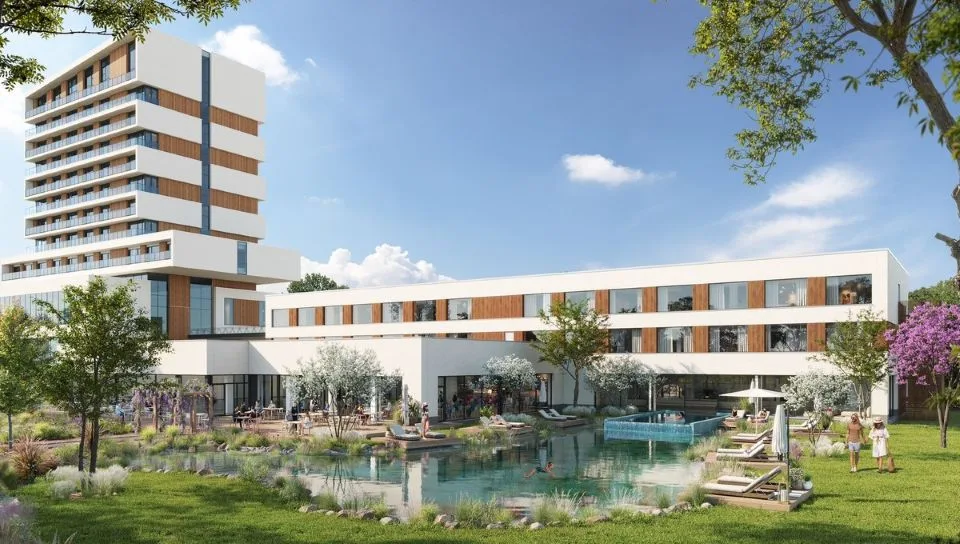
1. Urban Select-Service & Boutique Hotel Modules
Designed for mid-to-high-rise city center hotels. Engineered with heavy-gauge hot-rolled steel frames capable of stacking up to 10+ stories over a podium structure, delivering rapid urban densification with minimal street disruption.
- Structure: S350 Structural Steel / DfMA Load-bearing
- Pre-Fitment Level: 95% Factory Finished (Includes Bath Pods & FF&E)
- Target Brands: Hampton by Hilton, Moxy, Holiday Inn Express
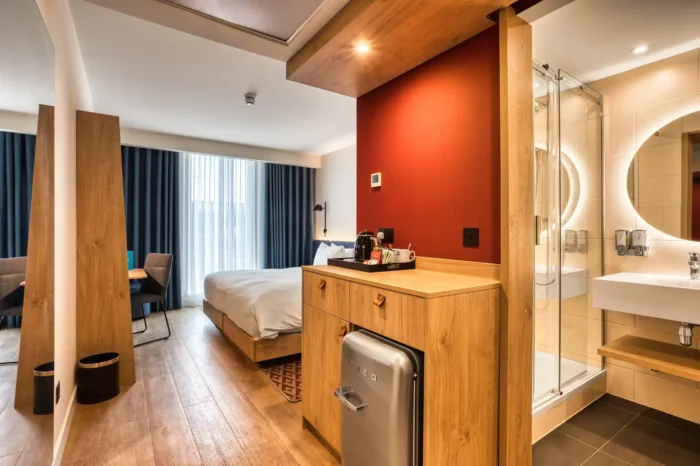
2. Turnkey Branded Guestroom Pods
Fully compliant with strict global hotel brand standards. Every module features integrated MEP corridors, specialized acoustic floating floor systems, precision joinery, and integrated Smart HVAC control systems built into the factory line.
- Acoustic Rating: STC 62 / DnT,w + Ctr > 53 dB
- Fire Resistance: REI 60 to REI 120 Fire-Rated Envelope
- Key Advantage: Absolute Brand Standard Uniformity
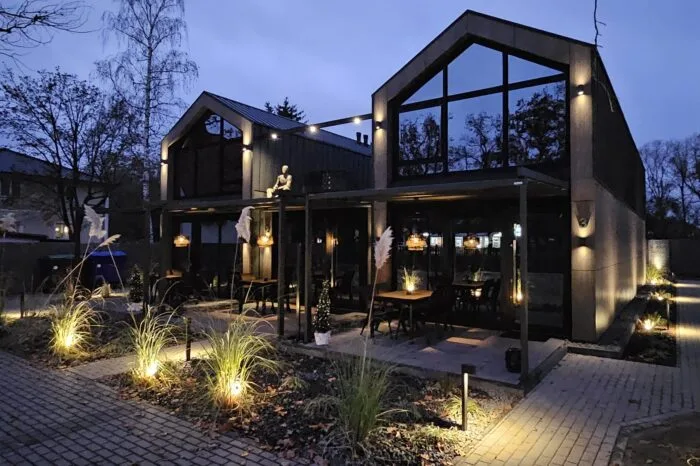
3. Extended Stay & Aparthotel Volumetric Units
Configured for dual-purpose hospitality and residential real estate assets (PRS/BTR hybrid). Features spatial layouts with integrated kitchenettes, structural double-pod configurations, and energy-efficient heat recovery systems.
- Module Widths: Up to 4.2m Transport Widths (EU/UK Compliant)
- Sustainability: Passivhaus & NZEB Ready Envelopes
- Target Use: Extended Stay America, Adagio, Staycity

4. Eco-Resort & Destination Hospitality Villas
Low-rise, high-architectural-impact volumetric units designed for remote, ecologically sensitive locations. Engineered for rapid foundation connection with minimal site grading and extreme climate thermal envelopes.
- Foundation Impact: Low-impact Micro-piling Compatibility
- Envelope Performance: U-values < 0.12 W/m²K
- Deployability: Rapid Crane Installation (Up to 8 pods/day)
Accelerate Your Hotel Project Schedule by 12+ Months
Partner with DMD Modular's international engineering team to review your architectural plans, assess volumetric feasibility, and obtain an off-site DfMA budget proposal.
4. Key Global Procurement & Industry Development Trends (2026–2035)
As the international construction landscape adapts to strict decarbonization mandates and volatile labor availability, institutional capital deployment in hospitality is prioritizing off-site volumetric solutions. Four major macro trends are reshaping global hotel procurement:
Trend 1: ESG Alignment & Embodied Carbon Taxation Compliance
International hotel chains and institutional real estate funds face expanding ESG reporting requirements (such as CSRD in Europe and SEC climate disclosures in North America). Traditional concrete hospitality builds generate massive scope 1, 2, and 3 carbon footprints. Volumetric steel modular construction naturally reduces embodied carbon through:
- Precision Structural Steel Allocation: Advanced DfMA algorithms eliminate material over-engineering, cutting raw material consumption by up to 25%.
- Factory Circularity: Over 90% of structural steel scrap generated during off-site cutting is immediately redirected into metallurgical recycling streams.
- Reduced Logistics Emissions: Consolidating hundreds of trade trips into optimized, batched module deliveries reduces heavy vehicle site transport emissions by up to 60%.
Trend 2: AI-Driven Generative DfMA & Building Information Modeling (BIM Level 3)
Modern volumetric modular hotel development no longer relies on conventional architectural drawings converted retroactively into modules. Leading procurement strategies integrate BIM Level 3 (LOD 400/500) early in the conceptual phase. Generative AI algorithms automatically optimize hotel floor plates, room dimensions, corridor MEP shafts, and structural column locations to align with modular factory transport constraints, eliminating structural clashes before factory tooling begins.
Trend 3: Supply Chain De-Risking via Capitalizing Off-Site Manufacturing
Inflationary pressures on raw materials and site labor have rendered traditional fixed-price contracts increasingly fragile, leading to main contractor insolvencies. Volumetric modular manufacturing fixes up to 80% of total construction costs in a factory environment under ISO 9001 quality audits. This mitigates price inflation risk and provides institutional lenders with guaranteed completion timelines, resulting in lower debt pricing and streamlined loan drawdowns.
Trend 4: Global Brand Standardization & Programmatic Scaling
Hospitality groups are moving away from bespoke, single-site traditional designs toward programmatic, repeatable volumetric module catalogs. By standardizing 3 to 5 volumetric room prototypes, hotel operators can roll out consistent, high-quality brand assets simultaneously across multiple geographic markets—including the UK, the Netherlands, Germany, Scandinavia, and island destinations—with zero architectural compromise.
5. Advanced Structural Engineering: Solving the Acoustic & Fire Challenges
A primary historical concern among hospitality buyers regarding modular construction is acoustic privacy between adjacent guestrooms and fire safety compliance across multi-story assemblies. DMD Modular’s structural engineering framework eliminates these risks through physics-backed DfMA design.
Double-Wall Structural Decoupling for Acoustic Superiority
In a traditional hotel build, guestroom partition walls consist of a single stud wall or concrete block wall, rendering them susceptible to sound flanking and structural vibration transmission. In contrast, a Volumetric Modular Hotel naturally creates a structural double-wall and double-floor assembly:
When two fully structural steel modules are installed adjacent to one another, they form two distinct, isolated wall frames separated by an engineered air cavity filled with acoustic mineral insulation. Additionally, specialized elastomeric neoprene acoustic isolation pads are positioned at every structural load-bearing connection point between stacked modules. This completely decouples mechanical vibrations and airborne noise, delivering sound transmission class ratings exceeding STC 60+ (DnT,w + Ctr > 53 dB) and impact insulation ratings exceeding IIC 60+, vastly superior to standard hotel requirements.
Fire Safety & High-Rise Structural Integrity
DMD Modular utilizes structural steel framing (hot-rolled structural sections combined with cold-formed light-gauge steel) compliant with European Eurocodes (EN 1993) and British Standards. Fire protection is engineered through multi-layer non-combustible gypsum linings, intumescent fire seals at module joints, and factory-installed fire stops in all vertical MEP penetrations. This structural system achieves certified REI 60 to REI 120 fire resistance, satisfying stringent international regulations for tall hospitality structures.
6. Enterprise Authority & Institutional Reliability: Why Leading Developers Choose DMD Modular
DMD Modular stands as an international leader in the volumetric modular construction industry. Based in Skawina, Poland (near Kraków), our advanced manufacturing facility delivers turn-key volumetric buildings across over 20 international markets, including the UK, the Netherlands, Denmark, Germany, Austria, and Iceland.
Institutional Financial backing: DMD Modular is backed by key shareholder FORUM TFI S.A.—the largest private equity investment fund manager in Central and Eastern Europe. This provides our global procurement partners with absolute financial stability, substantial bank guarantee capacity, and robust balance sheet security for large-scale multi-million-euro hotel portfolios.
Our organization’s commitment to technical mastery, quality assurance, and environmental leadership is verified through rigorous international standard certifications:
- ISO 9001 (Quality Management System): Full factory process control, rigorous raw material inspection, and continuous line auditing ensuring zero defect delivery.
- ISO 14001 (Environmental Management System): Sustainable off-site production practices, minimal scrap production, and eco-friendly supply chain integration.
- ISO 50001 (Energy Management System): Maximum energy efficiency throughout our automated manufacturing processes.
From initial DfMA feasibility modeling and 3D BIM integration through off-site manufacturing, international logistics, crane erection, and final site commissioning, DMD Modular acts as a comprehensive end-to-end technical partner for global hospitality leaders.
7. Frequently Asked Questions (Global Buyer & Investor FAQ)
Below are detailed, expert answers to the most common queries raised by international hotel procurement teams, general contractors, and investment committees regarding volumetric modular hotels:
Volumetric modular hotels engineered with structural steel frames have a structural design life equal to or exceeding traditional concrete or steel-framed buildings—typically 60 to 100+ years. DMD Modular uses high-grade corrosion-protected steel framing and factory-sealed building envelopes that prevent moisture intrusion, ensuring long-term structural integrity and high asset resale value.
During off-site factory fabrication, vertical MEP shafts, drainage stacks, electrical conduits, and hot/cold water distribution pipes are precisely pre-installed within dedicated module service cavities. Once the modules are stacked on-site, specialized connection access panels along main corridors allow mechanical engineers to rapidly tie-in, pressure-test, and seal vertical risers floor by floor, dramatically shortening MEP installation timelines.
Absolutely. While volumetric modules standardise internal room structures to maximize DfMA efficiency, exterior facade treatments remain completely flexible. Developers can apply any exterior cladding system—including brick slip, rainscreen panels, curtain walling, architectural timber, or natural stone. Internally, luxury joinery, high-end stone finishes, bespoke lighting, and premium fixtures are installed in the factory according to interior design specifications.
DMD Modular designs every 3D module to strictly adhere to international transport envelopes (standard road width, height, and weight restrictions across the EU, UK, and maritime shipping networks). Modules are fully shrink-wrapped in heavy-duty weatherproof protective membranes before leaving the factory floor and transported via specialized low-loader trailers or container shipping vessels directly to the job site for immediate tandem crane lifting.
Institutional lenders and banks favor volumetric modular construction because off-site DfMA drastically reduces project completion risk, weather delays, and budget overruns. Fixed-price manufacturing contracts and ISO-certified factory audits provide financial institutions with total cost transparency. Furthermore, opening 12–14 months earlier enables faster revenue collection, lowering total debt interest carrying costs during construction (IDC).
Partner with DMD Modular on Your Next Hotel Project
Contact our engineering and procurement team today to explore volumetric steel feasibility, architectural DfMA integration, and off-site manufacturing quotes for your global hospitality pipeline.