
1. Executive Summary & Market Dynamics of Modern PBSA
The global higher education market is facing an unprecedented structural imbalance. International student mobility has rebounded to record highs, yet prime university hubs across Europe, the UK, North America, and Australia suffer from severe structural deficits in Purpose-Built Student Accommodation (PBSA). Traditional on-site construction methods—hampered by volatile material pricing, acute skilled labor shortages, weather delays, and site disruption—can no longer meet the urgent speed-to-market demands of university intake cycles.
Volumetric Modular Student Accommodation represents a paradigm shift in real estate development. By shifting up to 90% of the build process into a precision-controlled factory environment, off-site construction transforms PBSA projects into predictable, standardized manufacturing workflows. This approach eliminates weather-induced schedule creep, mitigates capital risk for institutional funds, and guarantees that beds are operational and generating rental yield ahead of the critical September academic intake.
The PBSA Developer's Dilemma: Time-to-Market vs. Revenue Realization
In student housing developments, missing an academic term opening date by even two weeks means losing an entire year of room rental revenues. DMD Modular's 3D volumetric steel solution allows site infrastructure, foundation piling, and podium construction to occur simultaneously with module manufacturing, shortening total project delivery time by 30% to 50%.
2. Technical Architecture: Volumetric Steel Modules vs. Traditional Builds
Unlike 2D panelized systems or light-gauge steel framing that still require extensive multi-trade assembly on site, volumetric 3D steel modular construction delivers fully finished, structural spatial blocks directly to the foundation line. Each module leaves the manufacturing facility complete with structural chassis, fireproof wall linings, insulated external envelopes, integrated MEPH (Mechanical, Electrical, Plumbing, Heating) risers, fitted furniture, en-suite bathrooms, and complete interior finishes.
| Performance Metric | Traditional On-Site Build | 2D Panelized Prefab | DMD Volumetric Steel Modular |
|---|---|---|---|
| Schedule Reduction | Baseline (100% time) | 10% - 15% reduction | 30% - 50% faster completion |
| On-Site Labor Requirement | High (100+ trades on site) | Medium (30-50 trades) | Low (up to 75% fewer site hours) |
| Acoustic Isolation (Rw + Ctr) | 45 - 50 dB (trade quality dependent) | 50 - 52 dB | > 55 - 60 dB (Double-wall isolation) |
| Material Waste On-Site | 10% - 15% wastage | 8% - 10% wastage | < 2% factory controlled recycling |
| Financial Cost Certainty | Low (high overrun risk) | Moderate | High (Fixed off-site contract cost) |
Acoustic Separation & Sound Insulation Engineering
A primary technical hurdle in multi-occupancy student living is acoustic flank transmission. DMD Modular addresses this through structural double-wall and double-ceiling isolation. When two volumetric units are positioned side-by-side and stacked vertically, they form an independent, structural double-leaf barrier separated by specialized elastomeric acoustic isolation pads.
This structural decoupling prevents airborne and impact sound transmission between adjacent bedrooms and shared communal corridors, easily exceeding European building control thresholds (achieving tested sound reduction indices of Rw + Ctr > 55-60 dB). Student residents enjoy acoustic privacy optimized for focused studying and rest.
3. Product Recommendations: Turnkey Modular PBSA Layouts
To maximize Floor Area Ratio (FAR) and optimize operational yields for institutional investors, DMD Modular offers standardized, factory-engineered modular typologies tailored to international PBSA operational standards.
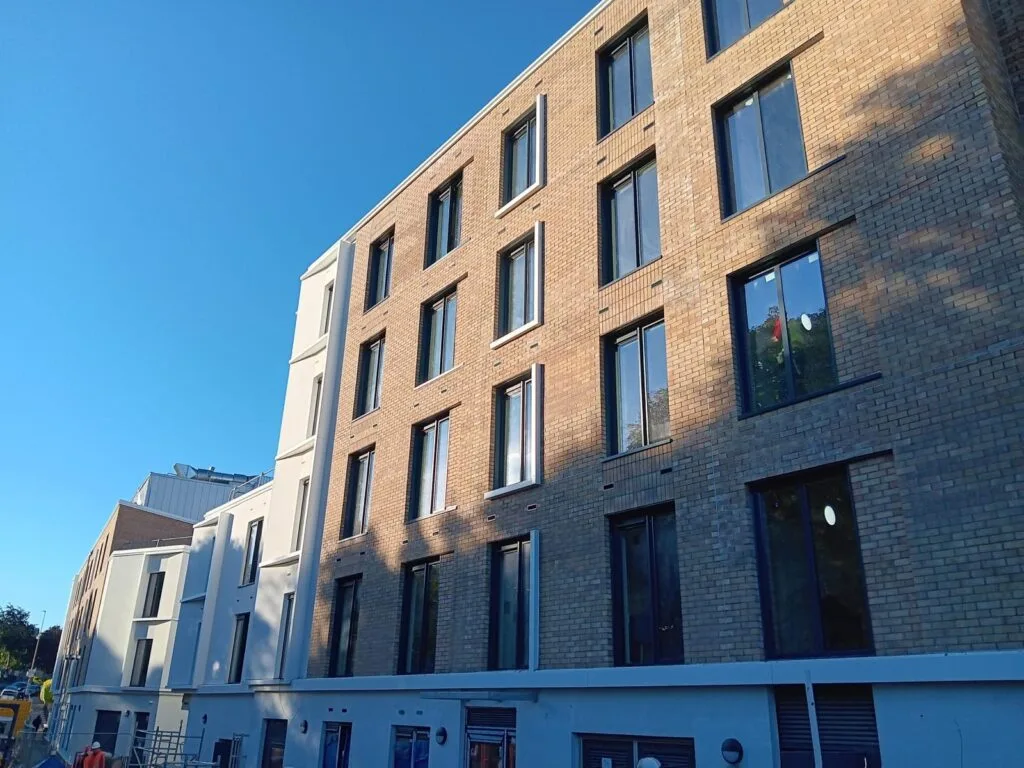
1. Turnkey PBSA Studio Pod
Fully independent self-contained studio unit designed for post-graduate and premium student accommodation developments.
- Floor Area: 18.5 m² – 24.0 m²
- Structure: Heavy Gauge Steel Chassis
- Fit-Out: Kitchenette, En-Suite, Bed, Desk
- Acoustic Rating: Rw 58 dB / L'n,w 42 dB
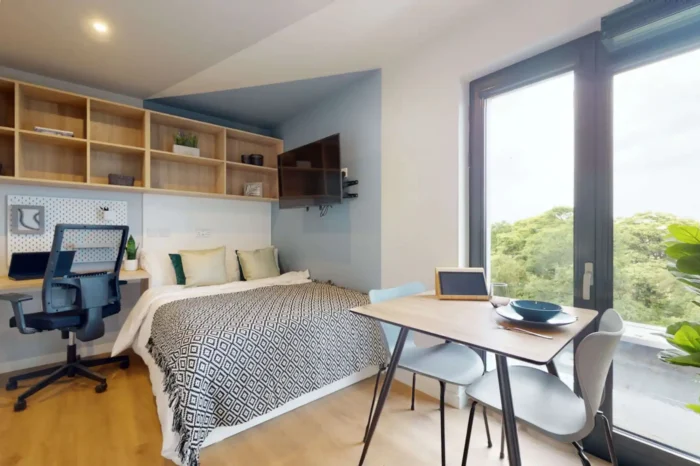
2. Cluster Apartment Bedroom Module
Optimized dual-bedroom or single en-suite module designed to connect seamlessly with shared kitchen and living common areas.
- Floor Area: 13.5 m² – 16.0 m² (per room)
- Bathroom: Fully tiled GRP/Steel Pod
- Fire Rating: REI 60 / REI 120 Compliant
- MEP: Pre-commissioned Plug & Play
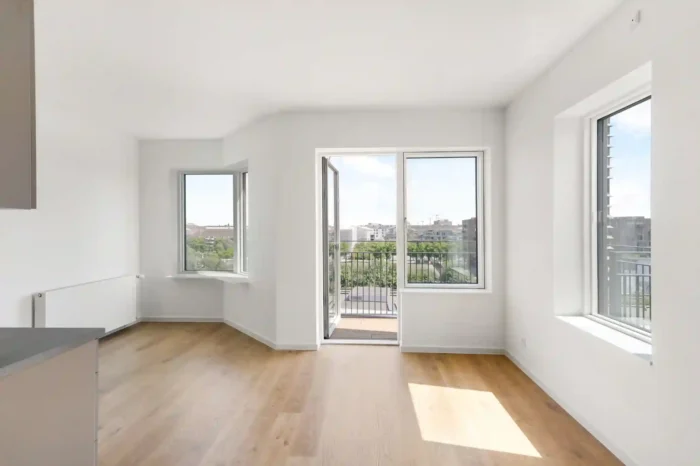
3. Accessible / DDA Modular Unit
Fully compliant barrier-free accessible student studio featuring expanded turning circles, wet-room facilities, and motorized joinery.
- Floor Area: 28.0 m² – 32.0 m²
- Compliance: DDA / Equality Act / BS8300
- HVAC: Integrated MVHR & Heat Pump
- Finish: Commercial-grade Vinyl / Laminate
4. Future Procurement Trends in Modular Student Housing (2025–2035)
As global institutional capital (ESG funds, REITs, sovereign wealth funds) dominates PBSA financing, procurement standards are evolving rapidly beyond basic cost-per-square-meter calculations. Investors require robust lifecycle performance, carbon compliance, and spatial adaptability.
A. Decarbonization, Embodied Carbon & Circular Economy
Real estate assets must align with stringent net-zero carbon benchmarks such as BREEAM Outstanding, LEED Platinum, and CRREM pathways. Volumetric steel modular construction naturally reduces embodied carbon by utilizing recycled structural steel profiles, optimizing thermal insulation envelopes, and drastically curbing transport emissions through consolidated factory logistics. Furthermore, structural steel modules can be dismantled, repurposed, or recycled at the end of the building’s design life, exemplifying true circular economy principles.
B. Smart Building Systems & Pre-Integrated IoT
Next-generation student housing integrates smart occupancy sensors, automated thermostatic radiator valves (TRVs), sub-metered electrical circuits, and keyless access control. Installing these systems during off-site factory assembly eliminates on-site chasing, wiring errors, and costly retrofitting. Every module leaves our facility pre-tested and ready to plug into central Building Management Systems (BMS).
C. Hybrid Modular Construction (Steel Volumetric + Timber Podium)
Future structural developments increasingly feature hybrid configurations: concrete or cross-laminated timber (CLT) podium structures on the ground and first floors (housing retail, student lounges, cinemas, and dining halls), topped with multi-story volumetric steel bedroom modules. This hybrid strategy balances architectural open-span flexibility on lower floors with rapid, standardized modular stacking above.
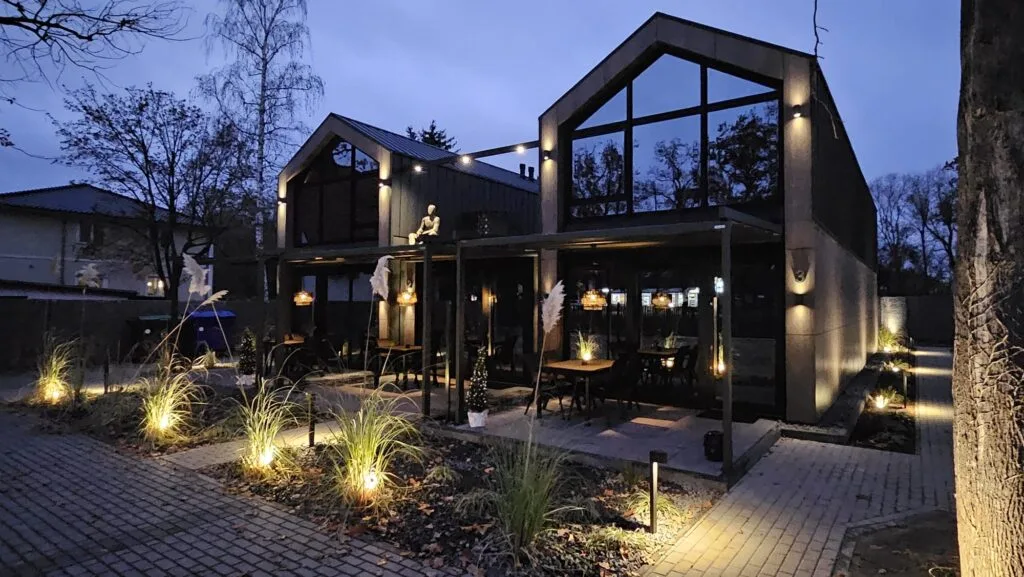
5. Enterprise Strengths: Why Institutional Investors Partner with DMD Modular
Selecting an off-site modular manufacturing partner requires rigorous operational, technical, and financial due diligence. DMD Modular stands as an established European leader in volumetric modular construction, backed by structural financial security and international project experience.
Financial Security & Capital Backing
DMD Modular is proudly backed by shareholder FORUM TFI S.A., managing the largest investment fund structure in Central and Eastern Europe. This institutional financial solidity gives developers, bank lenders, and insurers complete confidence in our project execution capability, bonded supply chains, and long-term warranties.
Certified Quality & Environmental Governance
Our state-of-the-art manufacturing facilities operate under fully integrated quality and energy management frameworks certified to ISO 9001 (Quality Management), ISO 14001 (Environmental Management), and ISO 50001 (Energy Management). Every weld, seal, and electrical connection is quality-checked and documented before site shipment.
Proven International Track Record across Europe & the UK
DMD Modular has successfully exported and installed volumetric steel projects across international jurisdictions including the United Kingdom, the Netherlands, Denmark, Germany, Belgium, Iceland, and Poland. For instance, our landmark PBSA project in Edinburgh, Scotland delivered 148 student living rooms with a total production window of just 9 months—saving the client 14 months of site construction time compared to conventional construction methods.
6. Procurement & Engineering FAQ for Modular Student Housing
Clear, authoritative answers to the top engineering, financial, and logistical questions asked by global procurement teams and institutional developers.
DMD Modular’s structural steel volumetric systems can stack self-supporting module configurations up to 10 to 12 stories without needing an external structural skeleton. For high-rise student accommodation towers exceeding 12 stories, our engineering team integrates volumetric modules within a central concrete core or structural steel podium frame, allowing developments to reach 20+ stories efficiently.
For optimal economic efficiency, engagement should take place during RIBA Stage 2 (Concept Design) / RIBA Stage 3 (Spatial Coordination). Implementing Design for Manufacture and Assembly (DfMA) early ensures grid dimensions, core locations, structural spans, and module transportation limits are optimized, avoiding costly architectural re-designs later on.
All DMD modular assemblies comply with strict European EN and UK Building Regulations (Approved Document B). Modules feature A1/A2 non-combustible insulation materials, intumescent fire stopping, and multi-layer structural boarding that achieves 60-minute to 120-minute structural fire resistance (REI 60 / REI 120), preventing horizontal or vertical fire spread.
Modules are designed within standard transport gauges for highway transit across continental Europe and shipment via sea freight to the UK or Nordic ports. Each unit features integrated corner castings for quick crane lifting and precise positioning on-site. DMD Modular oversees end-to-end logistics coordination, route permits, and just-in-time delivery schedules directly to site cranes.
Yes. DMD Modular buildings are designed for a 60+ year minimum design life. Our structural systems comply with major European warranty and insurance schemes (such as BOPAS in the UK and equivalent regional building guarantees). Institutional investors view volumetric steel modules as low-risk, highly durable real estate assets.