Discover latest news, architectural innovations, and expert perspectives on modular steel-frame construction across Europe.
Volumetric Modular Hotels are moving from niche experiments toward a serious option for international developers, operators, and procurement teams. Factory-built guest rooms can arrive with bathrooms, wiring, finishes, and furniture already installed. This changes the construction site. Instead of stacking materials in rain, teams may connect completed modules beside a prepared foundation.
The business case is gaining attention. McKinsey’s 2019 report, “Modular construction: From projects to products,” suggests modular methods can reduce construction schedules by 20–50% and potentially lower costs by up to 20%. The report also warns that these benefits depend on repeatable designs, reliable logistics, and early coordination. That warning matters. A delayed crane, narrow access road, or unsuitable local code can erase factory efficiency quickly.
Hotel demand adds further pressure. The World Travel & Tourism Council reported that travel and tourism contributed a record US$11.1 trillion to global GDP in 2024. More rooms are needed, but speed alone is not enough. Guests still notice bathroom seals, corridor acoustics, window performance, and the quietness of a room at 6 a.m.
This guide examines ten leading Volumetric Modular Hotels and related projects for global buyers. It considers manufacturing capability, delivery experience, design flexibility, sustainability evidence, certification, and after-sales support. Public data remains uneven. Some suppliers publish impressive claims without comparable project metrics. Buyers should ask harder questions, request verified references, and test assumptions before signing. A modular hotel can be efficient. It can also become an expensive shortcut when planning is weak.
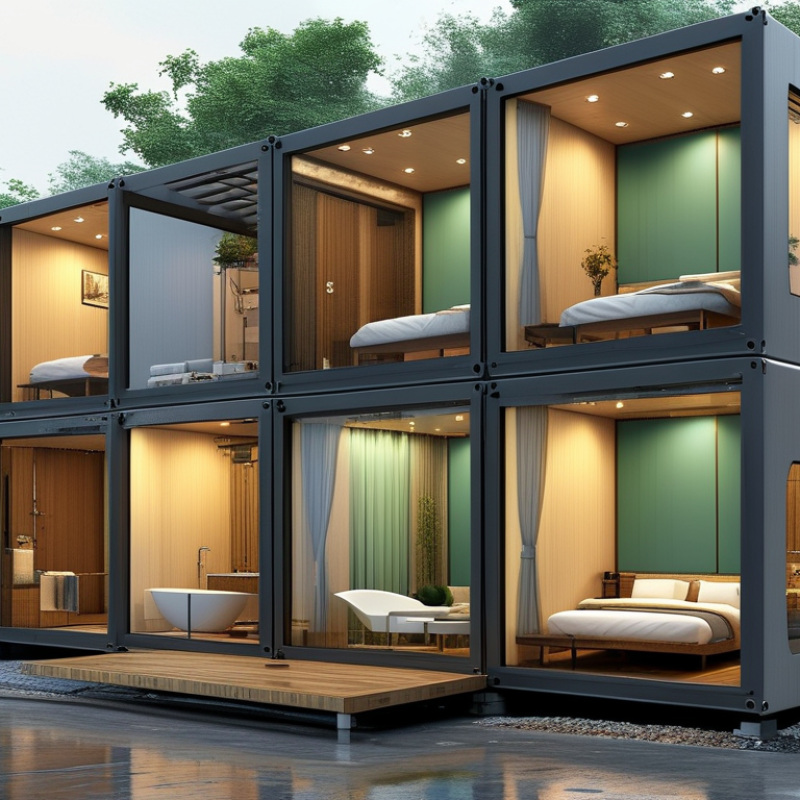
Volumetric modular hotels are buildings assembled from three-dimensional room modules. Each module is manufactured in a controlled factory, rather than built entirely on site. Workers install structure, insulation, wiring, plumbing, wall finishes, and bathroom fixtures before transport. A finished guestroom may leave the factory with lights, flooring, and furniture already fitted.
Construction begins with site surveys and foundation work. Meanwhile, factory teams produce identical modules using approved drawings and quality checks. Trucks then deliver the units to the project location. Cranes lift them into position, often stacking rooms floor by floor. Crews connect structural joints, utilities, corridors, fire systems, and exterior cladding. Local engineers must verify wind, seismic, fire, accessibility, and energy requirements. Factory accuracy helps, but it does not remove site risks. Transport damage, tight road access, or small foundation errors can delay installation. I have found that early coordination matters more than impressive factory speed.
Tips: Global buyers should request a clear production schedule, inspection records, material specifications, and a transport plan. Confirm who handles local approvals and utility connections. Check climate performance carefully; a coastal hotel needs different corrosion protection than a cold mountain property. Keep spare finishes and fittings for future repairs. Modular construction can reduce waste and shorten schedules, but rushed design decisions may create expensive changes later. Room repetition is efficient, not automatically flexible.
Volumetric modular hotels are assembled from three-dimensional room modules manufactured in a controlled factory environment and transported to the project site for installation. Industry benchmarks commonly report 60–90% factory completion, 20–50% potential schedule reduction, 10–30% potential construction-waste reduction, and up to 20% potential direct-cost reduction. Actual results vary by design, location, logistics, regulations, and project scale.
Top 10 Volumetric Modular Hotels for Global Buyers?
Key Criteria for Comparing Global Modular Hotel Projects
Global buyers should compare modular hotel projects through measurable evidence, not attractive renderings. Check room dimensions, factory tolerances, fire ratings, acoustic performance, and installation records. A 3,000-kilometre supply route can change the budget quickly. Confirm whether modules fit local road limits, cranes, ports, and site access.
Regulatory alignment matters. Ask for structural calculations, material certificates, inspection procedures, and approvals for the target country. Climate also affects performance. Coastal projects need corrosion protection, while cold regions require tested insulation and moisture control. Review bathroom waterproofing, ventilation, electrical systems, and replacement access. A sealed wall may look efficient, but hidden maintenance can become expensive.
Cost comparisons should include foundations, transport, customs, lifting, commissioning, staff training, and long-term repairs. Compare the same specification across suppliers. Otherwise, the cheapest proposal may simply exclude difficult work. Request factory visit evidence, sample-room inspections, production schedules, and independent quality reports. Speak with operators who have managed similar properties, not only project sellers.
Experience still needs questioning. A supplier may have many completed units but limited work across different codes or climates. That distinction matters. I would also test a full-size mock-up for sleep noise, corridor lighting, and housekeeping movement. Small operational problems become daily costs. Some estimates remain optimistic. Contingency planning should reflect weather delays, damaged modules, and late approvals.
Top 10 Volumetric Modular Hotels Across Major International Markets
The strongest ten markets include the United Kingdom, Germany, Norway, the United Arab Emirates, Saudi Arabia, Japan, Singapore, Australia, Canada, and the United States. Each market has different approval processes, transport limits, climate demands, and guest expectations. In London, compact room modules can reduce urban disruption. In northern Europe, factory-built bathrooms and insulated wall panels support cold-weather performance. Gulf projects often prioritize rapid installation and heat-resistant materials. Japan values precision, seismic planning, and limited site space. Singapore focuses on logistics, density, and strict quality control. Australia, Canada, and the United States often require flexible layouts for remote locations, workforce housing, or extended-stay hotels.
A reliable buying decision should examine factory records, moisture protection, fire testing, acoustic performance, and local certification. Buyers should also review installation photos, not only polished renderings. A finished module may look simple, but hidden details matter. Door alignment, drainage points, ventilation routes, and lifting connections can affect future maintenance. No ranking is perfect. Market conditions change quickly, and a suitable design in Dubai may fail in Vancouver. That weakness deserves honest discussion.
Tips: Compare delivered cost, not factory price. Request a sample room early. Confirm who manages permits, shipping, foundations, and final connections. Allow time for weather delays. Small planning gaps can become expensive site problems.
| Rank | International Market | Representative Hotel Segment | Typical Building Scale | Typical Guestroom Module | Factory Completion Level | Indicative On-Site Assembly | Primary Buyer Advantage |
|---|---|---|---|---|---|---|---|
| 1 | United Kingdom | Urban, airport and limited-service hotels | 6–12 storeys 120–300 keys |
18–25 m² gross internal area | 70–90%, including bathroom pod and MEP fit-out | Approximately 8–16 weeks for a repetitive mid-rise structure | Shorter city-centre programmes and reduced site labour demand |
| 2 | Germany | Business, roadside and workforce accommodation hotels | 3–8 storeys 80–220 keys |
18–26 m² gross internal area | 65–85%, with high pre-installation of services | Approximately 10–18 weeks | Factory quality control and predictable energy-performance detailing |
| 3 | Netherlands | Compact urban and transit-oriented hotels | 5–10 storeys 100–250 keys |
17–24 m² gross internal area | 75–90%, often using bathroom pods and repeatable room layouts | Approximately 8–14 weeks | Efficient use of constrained sites and rapid urban delivery |
| 4 | Sweden | Midscale, resort and seasonal accommodation hotels | 2–6 storeys 60–180 keys |
19–28 m² gross internal area | 70–90%, commonly with timber or hybrid volumetric construction | Approximately 8–16 weeks | High precision, low-waste production and suitability for cold climates |
| 5 | United States | Extended-stay, airport and suburban limited-service hotels | 3–6 storeys 80–250 keys |
22–32 m² gross internal area | 60–85%, depending on local code and transport distance | Approximately 10–20 weeks | Repeatable layouts, lower on-site headcount and schedule certainty |
| 6 | Canada | Remote, workforce, airport and regional hotels | 2–5 storeys 50–160 keys |
20–30 m² gross internal area | 65–85%, with robust insulation and pre-installed interior finishes | Approximately 10–18 weeks | Reduced exposure to severe weather and remote-site labour shortages |
| 7 | Japan | Business, capsule-influenced and compact city hotels | 6–15 storeys 150–400 keys |
12–22 m² gross internal area | 70–90%, with highly standardized bathroom and bedroom modules | Approximately 8–16 weeks | High dimensional accuracy and efficient use of small urban plots |
| 8 | Australia | Regional, mining-camp, airport and resort hotels | 1–5 storeys 40–180 keys |
20–30 m² gross internal area | 65–85%, with transportable room modules and bathroom pods | Approximately 8–18 weeks | Fast deployment in remote areas and reduced dependence on local trades |
| 9 | United Arab Emirates | Serviced apartments, workforce and midscale urban hotels | 5–12 storeys 120–350 keys |
20–32 m² gross internal area | 70–90%, with factory-controlled interior completion | Approximately 8–16 weeks | Lower site congestion, faster enclosure and consistent finish quality |
| 10 | Singapore | Compact urban, student-conversion and budget hotels | 8–20 storeys 150–500 keys |
16–25 m² gross internal area | 75–90%, subject to approved prefabricated construction systems | Approximately 10–18 weeks | Productivity gains on dense sites with limited storage and working space |
The strongest volumetric modular hotels combine precise design with practical operations. Leading projects use factory-built rooms, bathroom pods, and coordinated mechanical risers. This approach can shorten construction schedules by 20–50%, according to McKinsey’s 2019 Reinventing Construction report. Buyers should inspect factory quality records, transport routes, and local installation capacity. A beautiful module still fails if replacement parts arrive slowly.
Sustainability must appear in daily performance, not only in brochures. Heat pumps, low-flow fixtures, smart room controls, and high-performance façades can reduce operating demand. The International Energy Agency reports that buildings account for about 30% of global energy demand.
The 2023 UNEP Global Status Report places buildings and construction at 37% of energy-related and process emissions. These figures make energy monitoring essential. Request twelve months of comparable data. Design claims need proof.
Operational details separate promising projects from expensive experiments. Consider cleanable surfaces, accessible service panels, standardized furniture, and room layouts that support faster housekeeping. Digital sensors can identify leaks before carpets and ceilings suffer damage. Still, modular construction is not automatically low-carbon. Long-distance transport, concrete foundations, and replacement waste can weaken its benefits. This is often overlooked. A responsible buyer should compare embodied carbon, maintenance costs, guest comfort, and adaptation potential. The best ten projects are not identical; they respond intelligently to climate, regulations, labor conditions, and future room-use changes.
For developers, the best volumetric modular hotel is not always the fastest to install.
Factory-built rooms can reduce site disruption, improve quality control, and shorten the construction schedule. Yet transport routes, crane access, foundation tolerances, and local approvals can change the financial result. A detailed feasibility review should test each assumption.
Investors should examine the complete cost, not only the factory quotation. Include land preparation, shipping, lifting, utility connections, insurance, maintenance, and replacement cycles. Ask for documented factory inspections, material specifications, fire performance records, and delivery references from comparable projects. A low purchase price may hide expensive site work. That risk deserves attention.
Hotel operators need to assess the guest experience before signing a purchase agreement. Review room dimensions, acoustic insulation, bathroom durability, housekeeping movement, storage, and furniture replacement access. Mock-up rooms can reveal awkward details that drawings miss. Operational teams should also confirm technology integration, energy monitoring, accessibility, and emergency procedures. Some modular layouts look efficient but create difficult service routes. That is easy to underestimate. Contracts should define inspection points, defect response times, warranties, spare parts, and training responsibilities. Developers may prefer speed, while operators may need flexibility for changing room types or local demand. The strongest decision comes from comparing lifecycle performance, not impressive factory photographs.
It uses three-dimensional room modules made in a controlled factory. Workers install wiring, plumbing, insulation, flooring, lights, furniture, and bathroom fixtures before delivery.
Site crews prepare foundations while factory teams build the modules. Trucks deliver finished units. Cranes stack them floor by floor. Crews then connect joints, utilities, corridors, fire systems, and cladding.
It can reduce site work and shorten the schedule. Factory production and foundation work happen simultaneously. Not always. Poor coordination, damaged units, or late approvals can erase the time savings.
Request production schedules, inspection records, material specifications, and transport plans. Confirm who manages permits, foundations, utility connections, and final approvals. Ask for sample-room evidence, not only attractive drawings.
Coastal sites need stronger corrosion protection. Cold regions need tested insulation and moisture control. Hot climates may require heat-resistant materials. Local weather changes the specification.
Check road widths, bridge limits, ports, cranes, and site access. A long supply route can quickly increase costs. One tight corner matters.
Compare delivered cost, not only the factory price. Include foundations, transport, customs, lifting, commissioning, training, and future repairs. A cheap proposal may exclude difficult work.
Review fire ratings, acoustic performance, bathroom waterproofing, ventilation, electrical systems, and structural calculations. Inspect door alignment, drainage points, lifting connections, and maintenance access. Hidden defects become daily problems.
Repeated room modules improve efficiency, but they limit design flexibility. Different room sizes may require new layouts and tooling. Standardization helps. It can also become a constraint.
Allow for weather delays, transport damage, foundation errors, and late approvals. Keep spare finishes and fittings for future repairs. Some estimates stay optimistic. A realistic contingency is safer.
This article offers a practical guide to Volumetric Modular Hotels, explaining how guest rooms and building components are manufactured in controlled factory environments, transported, and assembled efficiently on site. It introduces the main criteria for comparing international modular hotel projects, including construction speed, design flexibility, quality control, transportation requirements, local regulations, lifecycle costs, and adaptability to different locations and market needs.
The overview examines ten representative Volumetric Modular Hotels across major global markets, focusing on their design approaches, sustainability strategies, energy performance, material choices, guest comfort, and operational efficiency. It also highlights how modular construction can support consistent room standards while reducing site disruption and improving project predictability. For developers, investors, and hotel operators, the article presents key buying considerations such as supplier capability, customization options, warranty support, installation planning, maintenance requirements, financing, and long-term business value.